Quick answer
The best general times to post on X/Twitter in 2026 are Tuesday through Thursday, 12-6 p.m. local time.
That comes from Sprout Social's 2026 analysis of nearly 2 billion engagements across roughly 307,000 social profiles. For X specifically, Sprout found these peak windows:
| Day | Strong posting windows |
|---|---|
| Monday | 2-3 p.m. and 5 p.m. |
| Tuesday | 12-6 p.m. |
| Wednesday | 12-6 p.m. |
| Thursday | 12-6 p.m. |
| Friday | test lightly, usually weaker |
| Saturday/Sunday | usually weakest |
Use that as a starting point, not a law.
Your best posting time depends on your audience, timezone, content type, and goal. A SaaS founder posting to builders will not behave exactly like a meme account, a local restaurant, or a finance creator.
Why timing still matters on X
X moves fast.
A good post can get buried if the first hour is dead. Timing will not save weak content, but it can help strong content get the first replies, bookmarks, and reposts it needs.
The practical rule:
Post when your audience is likely to be awake, bored enough to check the feed, and active enough to reply.
For most accounts, that means weekdays around lunch and afternoon. For global audiences, it means testing more than one timezone block.
The best weekly X posting schedule to start with
If you do not have enough analytics yet, start here:
| Goal | Best starting window | Why it works |
|---|---|---|
| reach | Tue-Thu, 12-3 p.m. | strong general engagement window |
| replies | Tue-Thu, 2-6 p.m. | people are more likely to join threads |
| founder/build updates | Mon-Thu, 12-5 p.m. | weekday builder audience is active |
| B2B posts | Tue-Thu, 10 a.m.-2 p.m. | catches workday browsing |
| creator posts | Tue-Thu, 12-6 p.m. | good baseline before testing audience data |
| launch reminders | Mon-Thu, 11 a.m.-5 p.m. | avoids weekend drop-off |
Keep times in the audience's local timezone whenever possible.
If most of your buyers are in the US, test Eastern and Pacific-friendly windows. If your audience is Europe/MENA, test late morning and afternoon in that region. If your audience is global, schedule the same idea in different formats across different windows instead of repeating the exact same post.
Best times by content type
Short founder updates
Best window: Tuesday to Thursday, 12-5 p.m.
These posts need replies more than anything. Post when your audience can answer quickly.
Example:
day 18 building timed post

fixed the bulk scheduling flow today

not sexy, but this is the stuff that saves people from opening 8 tabs every monday

what part of scheduling still feels annoying for you?
Threads and longer breakdowns
Best window: Tuesday or Wednesday, 12-3 p.m.
Threads need time to build momentum. Avoid posting them late at night unless your audience is clearly active then.
Post the thread when you can stay around for the first replies. A thread with zero early replies feels dead fast.
Launch posts
Best window: Tuesday to Thursday, 10 a.m.-2 p.m.
Do not launch into a weekend unless your audience is specifically weekend-heavy.
For a launch week, schedule the supporting posts in advance:
- teaser 2-3 days before
- launch announcement
- feature proof
- user pain post
- founder note
- reminder
- final CTA
If you are planning a launch campaign, pair this with the product launch scheduler guide.
Link posts
Best window: Tuesday to Thursday, 12-4 p.m.
Link posts can underperform if they look like drive-by promotion. Give the link a reason to exist.
Bad:
new blog post: example.com/article
Better:
posting on 5 platforms manually feels fine until you do it every day

then the mistakes start:
- wrong account
- wrong crop
- missing link
- caption too long

wrote the workflow i use to avoid that:
example.com/article
For more multi-platform workflow ideas, see how to manage multiple social media accounts.
Schedule your posts across every platform
Draft once, publish everywhere — automatically.
No credit card · Cancel anytime
How often should you post on X?
Start with 1-3 useful posts per day, then adjust based on your account.
For early founders and small brands, consistency matters more than volume. Ten rushed posts per day will not beat one sharp post that says something specific.
A simple weekly rhythm:
| Day | Post idea |
|---|---|
| Monday | what you are building this week |
| Tuesday | customer pain / useful lesson |
| Wednesday | feature, workflow, or behind-the-scenes post |
| Thursday | opinion or mini-case study |
| Friday | recap, ask, or light founder note |
Batch those posts once, then schedule them. That keeps you off the feed until it is time to reply.
How to find your actual best time
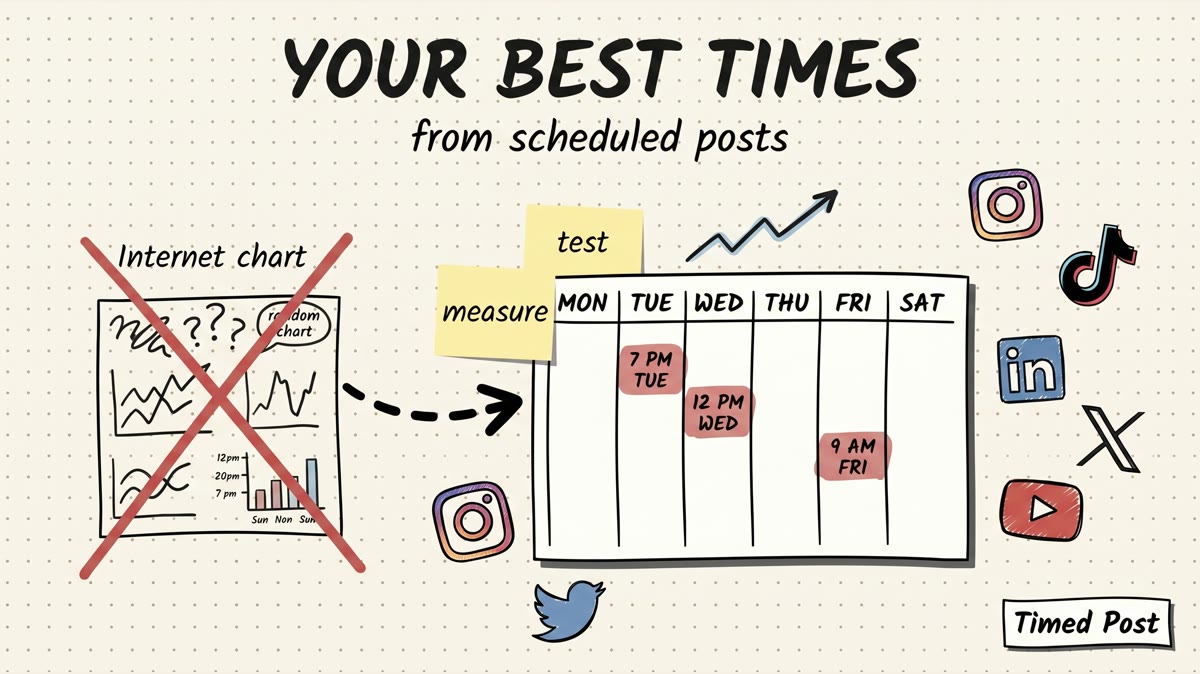
Benchmarks are useful, but your account data wins.
Run this 4-week test:
- Pick 3 posting windows: morning, midday, afternoon.
- Post similar content types in each window.
- Track impressions, replies, bookmarks, reposts, and profile clicks.
- Separate link posts from text-only posts.
- Repeat the winning window for two more weeks.
- Keep the best two windows and drop the weak one.
Do not judge by one post. X is noisy. You need patterns.
A basic test sheet can look like this:
| Field | What to record |
|---|---|
| date/time | when the post went live |
| post type | founder note, thread, link, launch, question |
| topic | what the post was about |
| impressions | reach |
| replies | conversation |
| bookmarks | usefulness |
| reposts | spread |
| profile clicks | buyer/lead interest |
If the goal is leads, do not optimize only for impressions. A smaller post with more profile clicks can be better than a viral post that brings the wrong people.
Best time is not the same as best content
This is where many timing articles become useless.
They give you a chart, but they do not fix the post.
Before blaming the time, check the content:
- Is the first line specific?
- Does the post create a reason to reply?
- Is there a real example, number, mistake, or opinion?
- Is the CTA human, or does it sound like marketing copy?
- Are you posting the same caption everywhere?
If the post reads like generic SaaS filler, 2 p.m. will not save it.
Mistakes to avoid
Posting only when you feel inspired
This creates gaps.
Keep a small scheduled queue so your account stays active even when you are busy building, selling, or answering customers.
Using one universal timezone
"Best time" should be local to the audience.
If your customers are in Morocco, Europe, and the US, test more than one block. A single 12 p.m. schedule may hit one audience and miss another.
Scheduling and disappearing
Scheduling gets the post live. It does not replace conversation.
For posts where replies matter, schedule the post for a time when you can check back in the first hour.
Copy-pasting the same post to every platform
X posts should feel like X posts: shorter, sharper, easier to reply to.
If you are also posting to LinkedIn, Instagram, Threads, or Facebook, adapt the same idea per platform. The best multi-platform social media scheduler guide covers that workflow in more detail.
A practical X schedule for founders
If you are building in public or growing a small SaaS, try this:
| Time | Post type |
|---|---|
| Monday 2 p.m. | weekly build note |
| Tuesday 12 p.m. | customer pain post |
| Wednesday 3 p.m. | feature/workflow example |
| Thursday 12 p.m. | lesson or mistake |
| Friday 2 p.m. | recap + simple ask |
Keep the posts simple. Use real numbers when you have them. Ask questions you actually want answers to.
Then use Timed Post to schedule the week in one batch and leave your feed closed until reply time.
Final takeaway
Start with Tuesday to Thursday, 12-6 p.m. local time.
Then run your own test.
If you are posting manually, timing experiments become annoying fast because you have to remember each window. In Timed Post, you can batch the week, schedule each X post into a test slot, and compare what actually works.
If your current workflow is "write post, open X, get distracted for 30 minutes," try Timed Post and schedule the batch before you open the app.