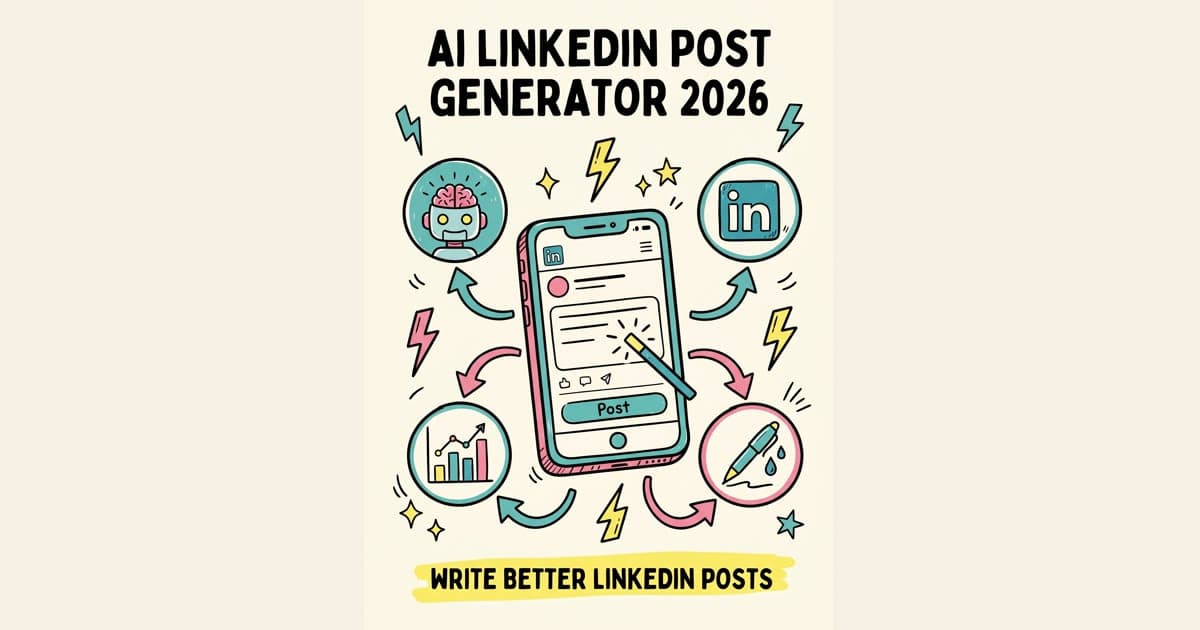
Meta description: Find the best AI LinkedIn post generator for 2026. Compare top tools, learn how to avoid sounding like a robot, and generate LinkedIn posts automatically.
You know you should post on LinkedIn. You open a blank draft, stare at it for four minutes, and close the tab. You have things to say. You just can't find the words fast enough, in the right tone, consistently enough to matter.
That's not a motivation problem. It's a time and format problem. LinkedIn has its own language: short punchy lines, personal hooks, credibility signals woven naturally into copy. Writing it well takes practice. Writing it consistently takes time most founders and marketers don't have.
That's why AI LinkedIn post generators have exploded in popularity. They don't replace your ideas. They turn your rough thoughts into polished, platform-ready content in seconds.
This guide covers the top tools available right now, how to use them without losing your voice, and the exact frameworks that produce LinkedIn posts worth reading.
What an AI LinkedIn Post Generator Actually Does
Before comparing tools, it helps to understand what's happening under the hood.
An AI LinkedIn content generator takes an input (a topic, a URL, a few bullet points, or even a voice note transcript) and produces formatted LinkedIn copy. The model has been trained on millions of high-performing LinkedIn posts, so it understands structure patterns: the one-sentence hook, the line break rhythm, the story arc that ends with a lesson.
Most tools work in one of three ways:
- Template-based: You fill in variables, the AI completes sentences around them. Fast, but formulaic.
- Prompt-based: You type a free-form instruction and the AI writes from scratch. Flexible, but needs good prompts.
- Repurpose-based: You paste a URL, article, or transcript and the AI extracts the key insight and formats it for LinkedIn. Highest ROI for content teams.
The better tools combine all three modes and let you set a tone, persona, or style. The best ones also let you schedule directly to LinkedIn without switching apps.
Why LinkedIn Content Is Harder to Write Than It Looks
LinkedIn isn't Twitter. It isn't a blog. It's its own format.
A post that works on LinkedIn usually has:
- A first line that interrupts the scroll. Curiosity, a surprising stat, or a blunt opinion.
- Short paragraphs (1-2 sentences max). White space is part of the format.
- A clear narrative arc. Even a 200-word post should have a beginning, middle, and point.
- A signal of credibility. "I've done this 40 times" lands differently than "experts say."
- An ending that prompts engagement. A question, a takeaway, or a challenge.
The LinkedIn algorithm also favors posts that generate early engagement (comments in the first hour matter most), stay native (no outbound links in the post body), and come from accounts that post consistently.
That combination of tone, structure, and frequency is why most people post once and disappear. An AI LinkedIn post writer removes the "blank page" problem. You still need ideas. The tool handles the execution.
Top 8 AI LinkedIn Post Generators Compared
1. Timed Post - Best for Founders and Agencies
Timed Post is built for people who want to generate LinkedIn posts automatically and get them scheduled without switching between three apps.
The workflow is simple: you describe your post idea or paste a URL, the AI generates LinkedIn-formatted copy, you review and edit, and then schedule it to publish directly to LinkedIn from the same dashboard. No copy-pasting. No tab-switching.
What makes Timed Post stand out is the "generate once, schedule everywhere" model. Your Starter plan ($19/month) covers 5 social accounts, and Growth covers 15 social accounts for $49/month. If you're posting across LinkedIn, Instagram, and X simultaneously, you create the content once and schedule it to all three. The AI adapts tone and format per platform automatically.
Best for: Founders, marketing teams, and agencies managing multiple clients or accounts.
Pricing: Free plan available. Pro at $19/mo.
What it does well:
- AI caption generation built into the scheduling flow
- Multi-platform scheduling from one dashboard
- No context-switching between tools
Limitation: Less LinkedIn-specific depth than Taplio (no feed analytics or DM automation).
Try Timed Post at timedpost.com
2. Taplio - Most LinkedIn-Specific
Taplio is purpose-built for LinkedIn. It offers an AI post writer, a content inspiration feed, post analytics, and basic relationship management (tracking who engages with your content).
The AI writing quality is solid. The tool understands LinkedIn format natively and can generate posts in your personal tone after you feed it examples of your past writing.
Best for: LinkedIn-focused creators and executives who want deep LinkedIn analytics alongside writing.
Pricing: Starts at $49/mo. Jumps to $99/mo for full features.
What it does well:
- Strong LinkedIn-specific content inspiration
- Tone matching based on your previous posts
- Post scheduling to LinkedIn
Limitation: Expensive. LinkedIn-only. Overkill for most users.
3. Jasper - Best for Content Teams
Jasper is a general-purpose AI writing platform that covers blog posts, ads, emails, social media, and more. It has a LinkedIn post template, but it's one of dozens of content types it handles.
For teams that already use Jasper for blog or ad copy, using it for LinkedIn posts as well makes sense. For someone who primarily wants a LinkedIn post generator, it's more tool than you need.
Best for: Marketing teams already using Jasper for broader content production.
Pricing: Starts at $49/mo for Creator plan.
What it does well:
- Broad content type coverage
- Team collaboration features
- Brand voice settings
Limitation: Not optimized for LinkedIn specifically. No native LinkedIn scheduling.
4. Copy.ai - Best Free Option for Occasional Use
Copy.ai has a generous free tier and an easy-to-use LinkedIn post generator. You pick a tone, describe your topic, and the tool returns a few variations.
The quality is decent for short, generic posts. It struggles with nuanced personal stories or industry-specific content. But for quickly generating a few post options to choose from, it works.
Best for: Solopreneurs who need occasional LinkedIn content without paying a monthly subscription.
Pricing: Free plan available. Pro at $49/mo.
What it does well:
- Good free tier
- Simple, fast interface
- Multiple post variations at once
Limitation: Generic output. No scheduling. Needs significant editing for professional-quality posts.
5. Shield - Best for Analytics-First Teams
Shield is primarily a LinkedIn analytics tool. It tracks post performance, audience growth, and engagement trends. The AI writing feature exists but is secondary to the analytics function.
If you need deep data on what's working on your LinkedIn account and want a basic writing aid bundled in, Shield is worth considering. If writing is your main goal, the AI capabilities are underwhelming compared to dedicated tools.
Best for: LinkedIn creators who want performance analytics as the main feature.
Pricing: Starts at $25/mo.
What it does well:
- Best-in-class LinkedIn analytics
- Content calendar view
- Historical performance data
Limitation: AI writing is a secondary feature, not a strength.
6. ChatGPT - DIY Approach (With Trade-offs)
ChatGPT can write LinkedIn posts. With the right prompt, it produces solid output. Many people use it this way.
The limitation is workflow. ChatGPT is a conversation interface, not a LinkedIn tool. You have to craft the prompt carefully every time (more on prompt frameworks later in this article), copy the output, paste it into LinkedIn or a scheduling tool, and start over for the next post.
There's no memory of your past posts, no tone consistency across sessions, and no scheduling capability. The quality ceiling is high if you're good at prompting. The consistency floor is low.
Best for: People who want full control and already pay for ChatGPT Plus.
Pricing: ChatGPT Plus at $20/mo.
What it does well:
- High quality ceiling with good prompts
- Flexible, no LinkedIn-specific limitations
- Already familiar to most users
Limitation: No scheduling, no workflow integration, inconsistent quality across sessions, requires prompt expertise.
7. Canva Magic Write (LinkedIn Templates)
Canva's Magic Write feature, combined with its LinkedIn post templates, is useful for visual content creators. You can generate a short caption and design a visual post within the same tool.
The AI writing quality is basic. This is most useful when you need a visual-first LinkedIn post (a graphic with a quote or stat) and want the caption to match.
Best for: Designers and creators who lead with visuals on LinkedIn.
Pricing: Included in Canva Pro at $15/mo.
What it does well:
- Design and copy in one tool
- Good for visual posts
- Easy for non-writers
Limitation: Weak AI writing quality. No scheduling. Not built for text-heavy LinkedIn posts.
8. LinkedIn's Native AI (Built-in)
LinkedIn now has a basic AI writing assistant built into the post editor. It can expand a sentence, suggest rewrites, or generate a full post from a short prompt.
The output is noticeably generic. It defaults to corporate-safe language and rarely produces the punchy, opinionated content that performs well. It's useful for a quick draft starter, but almost always needs heavy editing.
Best for: Users who don't want another tool subscription and just need a starting point.
Pricing: Free (included with LinkedIn).
What it does well:
- Built directly into LinkedIn
- Zero setup
- Decent at rewrites
Limitation: Generic output. No scheduling. Limited control over tone or format.
How to Use AI for LinkedIn Without Sounding Like a Robot
This is the most important section in this article.
Most AI-generated LinkedIn posts fail because they're technically correct but humanly wrong. They use phrases like "In today's fast-paced digital landscape" or end with "What are your thoughts?" after a bland observation. They read like a press release from a company no one likes.
Here's how to avoid that.
1. Give the AI a specific, personal hook
Don't say: "Write a LinkedIn post about time management."
Say: "Write a LinkedIn post about how I stopped booking back-to-back meetings and recovered 90 minutes a day. First line should be a blunt statement about how most calendars are self-inflicted chaos. I'm a founder, 6-person team, B2B SaaS."
The second prompt produces something you'd actually post. The specificity is the work.
2. Feed it your own words first
Type out your raw idea in 3-5 bullet points as if you were texting a colleague. Messy, unpolished, direct. Then give that to the AI and say "turn these notes into a LinkedIn post in my voice."
The AI is remixing your words, not inventing something generic. The output will sound more like you.
3. Edit the first sentence every time
AI hooks are often weak. "I used to struggle with X. Then I discovered Y. Here's what I learned." You've seen this 50 times this week.
Replace the first sentence with something you'd actually say out loud. That one change makes the whole post feel more human.
4. Remove corporate filler phrases
After generation, scan for:
- "In today's landscape..."
- "It's no secret that..."
- "At the end of the day..."
- "Game-changer"
- "Synergy"
- "Unlock your potential"
Delete them. Replace with direct statements.
5. Add one specific detail only you would know
A number, a name, a specific event, a date. "I tested this with 3 clients in Q1" beats "many professionals I've worked with." Specificity is credibility.
Schedule your posts across every platform
Draft once, publish everywhere — automatically.
No credit card · Cancel anytime
Best Prompt Frameworks for LinkedIn Content
These frameworks work with any AI LinkedIn post generator, including ChatGPT direct prompting.
The STAR Framework (for stories)
Situation - Task - Action - Result
Prompt: "Write a LinkedIn post using the STAR framework about [situation]. I [task], I [action], and the result was [result]. Keep it under 200 words. Hook should be the result, stated as a surprising outcome."
The Contrast Framework (for opinions)
What most people do vs. what actually works
Prompt: "Write a LinkedIn post contrasting [common belief] vs. [what I've found to be true]. Include [specific evidence]. End with an open question to the reader."
The List with a Twist (for tactical posts)
A numbered list where the last item is unexpected
Prompt: "Write a LinkedIn post structured as a list of [5-7 things] about [topic]. Items 1-4 are expected, standard advice. Item 5 or 6 should be the counterintuitive one that makes people stop. Do not use em dashes."
The Failure Post (for authenticity)
What went wrong and what it taught you
Prompt: "Write a LinkedIn post about a mistake I made with [topic]. The lesson is [insight]. Be direct and honest, not self-pitying. First line should not start with 'I'. 150-250 words."
The Data Post (for credibility)
A stat or number with your interpretation
Prompt: "Write a LinkedIn post about this stat: [stat + source]. Give 2-3 sentences of what this actually means in practice for [audience]. End with one clear takeaway. Tone: direct, founder-voice."
When to Use AI vs. Write Manually
AI is not the right tool for every LinkedIn post. Here's a practical breakdown.
Use AI when:
- You know what you want to say but can't get the format right
- You're repurposing content from another format (article, podcast, email)
- You need to generate multiple post variations to test
- You're behind on content and need to catch up quickly
- The post is primarily tactical or educational
Write manually when:
- The post is deeply personal (a loss, a milestone, a genuine moment)
- You have a strong, specific opinion that needs your voice to land
- You're building a reputation as a thinker in a specific niche
- The post references a real conversation, relationship, or internal experience
The best LinkedIn presences use both. AI handles the volume and consistency. Manual writing handles the moments that matter most.
How to Generate LinkedIn Posts Automatically Without Losing Quality
The phrase "generate LinkedIn posts automatically" can mean two different things.
The first is fully automated: a system that pulls from an RSS feed or topic list, generates posts, and publishes without your review. This approach produces consistent volume but often inconsistent quality. Unless you have a strong editorial layer, fully automated posting shows.
The second is semi-automated: AI generates the drafts, a human reviews and approves, and scheduling handles the publishing. This is the approach most serious LinkedIn creators use.
With a tool like Timed Post, the workflow looks like this:
- You set aside 30 minutes, once a week.
- You generate 5-7 LinkedIn post drafts from your topic list.
- You review, lightly edit each one.
- You schedule them to publish across the week.
- You're done. LinkedIn is handled.
That's not automation eliminating your voice. That's workflow eliminating your excuses.
If you want a starting point before the AI workflow, use these LinkedIn post templates for founders. If you just need a quick first draft, the LinkedIn post generator can turn the raw idea into something you can edit, format, and schedule.
Frequently Asked Questions
What is an AI LinkedIn post generator?
An AI LinkedIn post generator is a software tool that uses large language models to create LinkedIn-formatted content from a prompt, URL, or topic description. These tools understand the structure of high-performing LinkedIn posts, including short paragraphs, strong first lines, and clear narrative arcs, and produce draft content in seconds. You review and edit the output, then publish or schedule it. Most tools offer tone controls, multiple variations, and some include direct scheduling to LinkedIn. They are used by founders, marketers, and agencies to produce consistent LinkedIn content without spending hours writing from scratch.
Is there a LinkedIn post generator that is free?
Yes. Several tools offer free plans. Copy.ai has a free tier with limited monthly credits that works for occasional LinkedIn posts. LinkedIn's own built-in AI writing assistant is free for all users directly inside the post editor. Timed Post offers a 7-day free trial and built-in AI caption generation on paid plans. For higher volume and better quality, paid plans typically start at $15-$19 per month. ChatGPT (free version) can also generate LinkedIn posts with good prompts, though it requires more manual effort and has no scheduling capability.
How do I make AI-generated LinkedIn posts sound more human?
The most effective technique is to provide specific, personal input rather than a generic topic. Tell the AI who you are, what specifically happened, and what you want readers to feel or do. After generating, replace the first sentence (AI hooks are often weak), remove filler phrases like "in today's landscape" or "it's no secret that," and add one specific detail, a number, name, or date, that only you would know. The goal is to use AI for structure and efficiency while keeping the human specificity that makes LinkedIn content worth reading.
What is the best AI LinkedIn content generator for agencies?
For agencies managing multiple client LinkedIn accounts, the best option is a tool that combines AI writing with multi-account scheduling. Timed Post is built for this use case: Starter starts at $19/month for 5 social accounts, and Growth covers 15 social accounts for $49/month, making it cost-effective for teams posting across channels. Taplio is strong if clients want LinkedIn-only depth, but at $49-$99/month per account it gets expensive at scale. Jasper works for agencies already using it for broader content but adds cost without LinkedIn-specific value.
Can I use an AI LinkedIn post writer to repurpose blog content?
Yes, and this is one of the highest-ROI use cases. You paste a blog post URL or content into the AI tool, prompt it to extract the single most important insight and format it as a LinkedIn post, and in most cases get a solid first draft. You can generate 3-5 different LinkedIn angles from one blog post, scheduling them over several weeks. This approach lets content teams get significantly more mileage from existing content without writing anything new from scratch.
How often should I post on LinkedIn?
Most research on LinkedIn algorithm performance points to 3-5 posts per week as the optimal frequency for growth. Daily posting works if you can maintain quality, but consistency matters more than volume. One post per week is enough to maintain visibility but rarely enough to grow. The practical approach for most founders and marketers: batch-create content once a week using an AI LinkedIn post generator, schedule 4-5 posts, and spend your daily time engaging with comments rather than writing new posts in the moment.
Does using an AI LinkedIn post generator hurt engagement?
No, as long as the content is specific, useful, and edited for your voice. Generic AI posts, ones that could have been written by anyone about anything, do underperform because they lack credibility signals and personal specificity. But a well-prompted, edited AI post is indistinguishable from manually written content and performs equally well. The engagement variable is content quality and specificity, not whether a human or AI typed the first draft.
What is the difference between Taplio and Timed Post for LinkedIn?
Taplio is a LinkedIn-only tool with deep analytics, a content inspiration feed, and basic CRM features for relationship tracking. It starts at $49/month. Timed Post is a multi-platform scheduling tool with built-in AI caption generation, covering LinkedIn plus other major platforms starting at $19/month. If you are exclusively focused on LinkedIn and want detailed analytics on post performance, Taplio is the stronger tool. If you post across multiple platforms or want the best cost-per-feature ratio, Timed Post is more practical for most founders and marketing teams.
How do I schedule LinkedIn posts automatically?
To schedule LinkedIn posts automatically, connect your LinkedIn account to a scheduling tool like Timed Post. Create your post content, set the date and time you want it published, and the scheduler handles the rest. Most tools publish directly to LinkedIn via the official API, so posts appear natively with no third-party branding. With Timed Post, you can generate the post with the built-in AI writer and schedule it in the same workflow, without switching between apps. This makes batch scheduling, creating a week of content in one session, significantly faster.
Are AI LinkedIn post generators safe for my account?
Yes, when the tool uses LinkedIn's official API. Reputable tools like Timed Post connect through LinkedIn's authorized partner API, which means scheduling and posting is fully compliant with LinkedIn's terms of service. Tools that use unofficial scraping or browser automation carry higher risk. Before connecting any tool to your LinkedIn account, check that it uses OAuth authentication through LinkedIn directly and that it appears on LinkedIn's list of approved marketing partners or uses their official API. Timed Post uses the official LinkedIn API.
The Bottom Line
An AI LinkedIn post generator doesn't make you a better writer. It removes the friction that stops you from showing up consistently.
You still need to know what you want to say. You still need to review the output and add your specific details. You still need to engage with the people who comment.
What you don't need to do is stare at a blank page for 20 minutes every time you want to post.
The best tool is the one you'll actually use. If you want LinkedIn writing and scheduling in one place without paying enterprise pricing, Timed Post is the practical choice. Generate your content, schedule it, and get back to the work that actually moves your business.