Managing one social media platform is straightforward. Managing seven? That's where most creators and brands fall apart.
The instinct is to copy-paste the same content everywhere. Post your Instagram photo to Facebook, LinkedIn, X, TikTok, and call it a day. But here's the problem: audiences on different platforms have different expectations, behaviors, and content preferences.
A professional LinkedIn post lands flat on TikTok. A casual Instagram Reel feels weird on LinkedIn. Identical captions everywhere scream "I don't actually care about this platform."
But creating totally unique content for each platform? That's 7x the work, which isn't sustainable for solo creators or small teams.
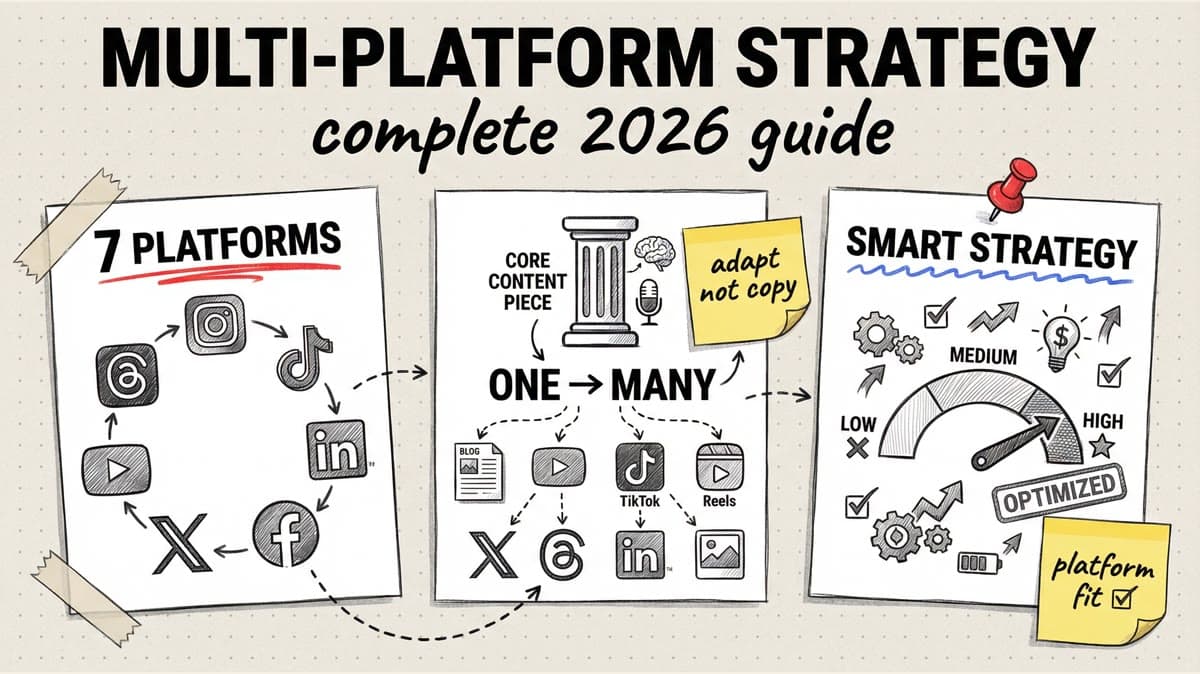
The smart approach: Strategic multi-platform distribution. Create once, adapt intelligently, publish everywhere.
This guide breaks down the exact framework agencies use to maintain presence on Instagram, TikTok, LinkedIn, Facebook, X, YouTube, and Threads without burning out or sounding like a robot.
You'll learn:
- How to categorize your content for maximum platform fit (Section 1)
- The content matrix that shows which formats work where (Section 2)
- Platform-specific adaptation rules that prevent copy-paste disasters (Section 3)
- The posting frequency sweet spot for each platform (Section 4)
- Cross-posting workflows that save 10+ hours per week (Section 5)
The Multi-Platform Mistake 95% of Brands Make
Before diving into strategy, let's identify the failure mode.
Bad multi-platform strategy: "Spray and pray"
Create content for Instagram (because that's where you're comfortable), then copy-paste it to LinkedIn, Facebook, TikTok, X, YouTube, and Threads. Same image, same caption, same hashtags, posted at the same time.
Why this fails:
- LinkedIn audiences want professional insights, not Instagram aesthetic photos
- TikTok demands vertical video, not static images
- X (Twitter) thrives on punchy text, not long captions with 20 hashtags
- YouTube Shorts need hooks in the first 3 seconds, Instagram Reels allow slower builds
Result: Mediocre performance across all platforms. You're present everywhere but connecting nowhere.
Good multi-platform strategy: "Create pillar content, adapt per platform"
Create one substantial piece of "pillar content" (a blog post, video, podcast), then strategically adapt it to match each platform's native format and audience expectations.
Example: One blog post becomes 8 platform-optimized posts
Original pillar: Blog post titled "7 Ways to Save Time on Social Media"
| Platform | Adapted Format | Key Changes |
|---|---|---|
| 7-slide carousel | Visual-first, minimal text per slide | |
| Long-form text post | Professional tone, expanded on insight #1 | |
| TikTok | 60-sec video | Talking head, conversational, hook in first 2 seconds |
| X | 8-tweet thread | Punchy, numbered, thread structure |
| Link share + excerpt | Longer caption, emphasis on community | |
| YouTube | 3-min video | Deep dive on insight #1, SEO-optimized title |
| Threads | Casual insight | Conversational tone, one key takeaway |
| Infographic | Visual representation of all 7 strategies |
Same core value, 8 different executions tailored to platform norms.
Section 1: Content Categorization for Platform Fit
Not all content works on all platforms. Before you create, categorize your content type and determine natural platform fit.
Content Categories:
Category 1: Educational / How-To
Content that teaches something practical.
Examples:
- "5 tips for better engagement"
- "How to schedule posts in advance"
- "Instagram algorithm explained"
Best platforms:
- ✅ LinkedIn (professionals seeking career growth)
- ✅ Instagram (carousels and Reels with tutorials)
- ✅ YouTube (long-form deep dives)
- ✅ TikTok (quick tips, hacks)
- ⚠️ X (works as threads, less as single tweets)
- ❌ Pinterest (unless visualized as infographic)
Category 2: Inspirational / Motivational
Content designed to inspire or spark emotional connection.
Examples:
- Success stories
- Before-and-after transformations
- Motivational quotes
- Founder journey posts
Best platforms:
- ✅ Instagram (highly visual, emotional)
- ✅ LinkedIn (career inspiration, founder stories)
- ✅ Facebook (community-focused, shares well)
- ⚠️ X (works if packaged as narrative threads)
- ❌ TikTok (less effective unless video-based)
Category 3: Behind-the-Scenes
Content showing process, team, or company culture.
Examples:
- Office tours
- Team introductions
- "A day in the life"
- Product creation process
Best platforms:
- ✅ Instagram (Stories, Reels)
- ✅ TikTok (authentic, casual vibe)
- ✅ LinkedIn (company culture recruiting)
- ✅ YouTube (longer-form documentation)
- ⚠️ X (can work as photo threads)
- ❌ Pinterest (low discovery)
Category 4: Product / Promotional
Content explicitly selling or showcasing products.
Examples:
- Product launches
- Feature announcements
- Sales and discounts
- Testimonials
Best platforms:
- ✅ Instagram (product photography, shopping tags)
- ✅ Facebook (community, retargeting ads work well)
- ✅ Pinterest (high purchase intent)
- ⚠️ LinkedIn (B2B products only, not consumer)
- ⚠️ TikTok (works if not overly sales-y)
- ❌ X (low tolerance for promotional content)
Category 5: News / Industry Insights
Timely commentary on trends, news, or data.
Examples:
- Industry reports
- Market analysis
- Platform updates
- Trend breakdowns
Best platforms:
- ✅ LinkedIn (thought leadership)
- ✅ X (real-time commentary)
- ✅ Threads (breaking news, hot takes)
- ⚠️ Instagram (can work as carousels)
- ❌ TikTok (too slow for breaking news)
- ❌ Pinterest (not timely)
Category 6: Entertainment / Memes
Content designed to entertain or make people laugh.
Examples:
- Memes
- Relatable humor
- Parody videos
- Trends and challenges
Best platforms:
- ✅ TikTok (viral potential)
- ✅ Instagram (Reels, memes)
- ✅ X (fast-moving humor)
- ✅ Threads (casual, conversational)
- ⚠️ Facebook (works for older demographics)
- ❌ LinkedIn (rarely appropriate)
The categorization rule: Choose platforms based on content type, not just "where my audience is."
If you create educational content, prioritize LinkedIn and YouTube over Facebook and Threads, even if Facebook has more users.
Section 2: The Platform Content Matrix
This matrix shows which formats perform best on each platform. Use it to decide how to adapt your pillar content.
| Platform | Top Formats | Ideal Length | Tone | Hashtag Strategy |
|---|---|---|---|---|
| Reels, Carousels, Stories | Reels: 15-60s, Carousels: 5-10 slides | Casual, visual, aspirational | 15-30 hashtags | |
| TikTok | Short-form video | 15-90s (sweet spot: 30-45s) | Authentic, entertaining, fast-paced | 3-5 hashtags |
| Text posts, carousels, articles | Text: 150-300 words, Carousels: 6-10 slides | Professional, insightful, data-driven | 3-5 hashtags | |
| Link shares, video, community posts | Video: 1-3 min, Text: 100-250 words | Community-focused, conversational | 1-3 hashtags | |
| X (Twitter) | Threads, single tweets, polls | Single: 50-100 chars, Threads: 5-10 tweets | Punchy, opinionated, real-time | 1-2 hashtags max |
| YouTube | Long-form video, Shorts | Long: 8-20 min, Shorts: 15-60s | Educational or entertaining, SEO-focused | Tags in description |
| Threads | Text posts, casual conversations | 100-300 characters | Conversational, unpolished, real | 0-2 hashtags |
| Infographics, tall images | Images: 1000x1500px | Inspirational, actionable, evergreen | Keywords in description |
How to use this matrix:
- Create your pillar content (e.g., a blog post)
- Identify which platforms match your content category
- Adapt the format to match the "Top Formats" column
- Adjust tone and length per platform
Example: Repurposing "5 Instagram Growth Tips" blog post
- Instagram: 5-slide carousel, casual tone, 20 hashtags
- LinkedIn: Long-form text post expanding on tip #1, professional tone, 3 hashtags
- TikTok: 45-second video walking through all 5 tips, fast-paced, trending sound, 4 hashtags
- X: 6-tweet thread, punchy 1-2 line tips, no hashtags
- YouTube: 10-minute deep dive on tip #1, SEO title "Instagram Growth Strategy 2026"
- Threads: Conversational post: "Hot take: most Instagram advice is outdated. Here's what actually works in 2026..."
- Pinterest: Infographic visualizing all 5 tips, keyword-rich description
Section 3: Platform-Specific Adaptation Rules
Copy-pasting captions across platforms is lazy and ineffective. Follow these rules for each platform:
Instagram Adaptation Rules
Format preferences:
- Reels > Carousels > Single images
- Vertical video (9:16) performs best
- High-quality visuals are non-negotiable
Caption style:
- Start with a hook (first line visible before "...more")
- Emojis are expected and encouraged
- Longer captions work (up to 2,200 characters)
- CTA: "Link in bio," "Save this post," "Send to a friend"
Hashtag strategy:
- Use 15-30 hashtags
- Mix high-volume and niche tags
- Rotate hashtag sets to avoid spam detection
TikTok Adaptation Rules
Format preferences:
- Vertical video only (9:16)
- Hook in first 2-3 seconds or viewers scroll
- Native editing (CapCut, TikTok editor) performs better than polished external edits
Caption style:
- Short and punchy (80-100 characters ideal)
- Minimal emojis
- Pose a question or tease the content
- CTA: "Follow for part 2," "Drop a comment if you agree"
Hashtag strategy:
- Use 3-5 hashtags
- Include 1-2 trending hashtags (even if loosely related)
- Avoid generic tags like #fyp
LinkedIn Adaptation Rules
Format preferences:
- Text posts > Carousels > Links (LinkedIn buries link posts)
- Professional headshots and clean graphics
- Data and charts perform well
Caption style:
- Professional but not stiff
- Start with a bold statement or question
- Break text into short paragraphs (3-4 lines max)
- CTA: "What's your take?", "Share your experience in the comments"
Hashtag strategy:
- Use 3-5 relevant hashtags
- Focus on industry-specific tags (#B2BMarketing, #SaaS)
- Avoid overused generic tags (#Marketing)
Facebook Adaptation Rules
Format preferences:
- Native video > Link shares > Images
- Community-focused content (polls, questions, conversations)
- Longer content works (Facebook audiences skew older)
Caption style:
- Casual, friendly, community-oriented
- Longer captions are fine (300-500 words)
- Storytelling works well
- CTA: "Tag someone who needs this," "Share your story below"
Hashtag strategy:
- Use 1-3 hashtags max
- Facebook hashtags are weak for discovery
- Focus on community building over reach
X (Twitter) Adaptation Rules
Format preferences:
- Text tweets > Images > Links
- Threads for longer ideas
- Polls for engagement
Caption style:
- Punchy, opinionated, conversational
- 50-150 characters ideal for single tweets
- No fluff, get to the point
- CTA: "Retweet if you agree," "Reply with your take"
Hashtag strategy:
- 0-2 hashtags max
- Hashtags feel spammy on X
- Use trending hashtags only if genuinely relevant
YouTube Adaptation Rules
Format preferences:
- Long-form video (8-20 min) for main channel
- Shorts (15-60s) for quick tips
- SEO-optimized titles and descriptions
Caption style:
- Title: Front-load keywords, include numbers ("7 Ways to...")
- Description: First 150 characters matter (shows in search results)
- Timestamps for long videos
- CTA: "Subscribe for more," "Check out the blog post (link)"
Hashtag strategy:
- Use 5-10 tags in description
- Include broad and specific tags
- First 3 hashtags show above title
Threads Adaptation Rules
Format preferences:
- Short text posts (100-500 characters)
- Casual, conversational, unpolished
- Images and videos work but text-first
Caption style:
- No pressure to be perfect
- Hot takes and opinions
- Conversational, like texting a friend
- CTA: "Thoughts?", "Am I crazy or..."
Hashtag strategy:
- 0-2 hashtags
- Hashtags feel out of place on Threads
- Focus on conversation over discovery
Schedule your posts across every platform
Draft once, publish everywhere — automatically.
No credit card · Cancel anytime
Section 4: Optimal Posting Frequency Per Platform
More isn't always better. Each platform has a sweet spot for posting frequency.
| Platform | Recommended Frequency | Why |
|---|---|---|
| 4-7 posts/week + daily Stories | Algorithm favors consistency, but oversaturation hurts engagement | |
| TikTok | 1-3 videos/day | High-volume platform, more posts = more chances to go viral |
| 3-5 posts/week | Professional audience, too frequent feels spammy | |
| 3-5 posts/week | Declining organic reach, quality > quantity | |
| X (Twitter) | 3-10 tweets/day | Fast-moving feed, more activity is acceptable |
| YouTube | 1-2 long videos/week + 3-5 Shorts/week | Production-heavy, less frequent but higher quality |
| Threads | 2-5 posts/day | Casual, conversational, higher frequency is fine |
| 5-10 pins/day | Evergreen content, high volume drives discovery |
The rule: Match posting frequency to platform culture, not your capacity.
If you can only create 10 pieces of content per week total, prioritize platforms with lower frequency needs (LinkedIn, YouTube, Facebook) over high-frequency platforms (TikTok, Threads).
Section 5: The Cross-Posting Workflow That Saves 10+ Hours/Week
Now that you understand platform differences, here's the workflow to publish everywhere without 7x the work.
Step 1: Create pillar content (90 min/week)
Choose one format:
- Write a blog post (1,000-2,000 words)
- Record a YouTube video (10-20 min)
- Produce a podcast episode (30-60 min)
Step 2: Map to platforms (10 min)
List which platforms match this content category (use Section 1 guidance).
Example: Educational blog post = Instagram, LinkedIn, TikTok, X, YouTube, Pinterest
Step 3: Adapt per platform (60 min total)
Use the Platform Content Matrix (Section 2) and Adaptation Rules (Section 3):
- Instagram: Pull 5 key tips → carousel (15 min)
- LinkedIn: Expand on tip #1 → long-form post (10 min)
- TikTok: Record 60-sec summary → talking head video (20 min)
- X: Break into thread → 8 tweets (10 min)
- YouTube: Clip best 60 seconds → Short (5 min)
- Pinterest: Visualize framework → infographic (15 min using Canva template)
Total adaptation time: ~75 min for 6 platform-native posts
Step 4: Schedule everything (15 min)
Upload all 6 posts to your scheduler:
- Assign to correct platforms
- Set optimal posting times (use smart scheduling)
- Add platform-specific hashtags
- Done
Total workflow time: 90 min (pillar) + 10 min (mapping) + 75 min (adaptation) + 15 min (scheduling) = 3 hours
Output: 6-8 posts across 6-7 platforms
Compare to creating unique content per platform:
Unique approach: 30-45 min per platform × 7 platforms = 3.5-5.25 hours for 7 posts
Cross-posting workflow: 3 hours for 6-8 posts across 7 platforms
Time saved: 0.5-2+ hours/week, with better quality (rooted in well-researched pillar content)
The Multi-Platform Strategy Framework
Pulling it all together:
Monday: Plan + Create Pillar Content (90 min)
- Choose topic based on audience needs
- Create pillar content (blog, video, podcast)
Tuesday: Adapt and Schedule (90 min)
- Map content to platforms
- Adapt format and tone per platform
- Schedule everything for the week
Wednesday-Friday: Engagement (15 min/day)
- Reply to comments across all platforms
- Join conversations
- Monitor performance
Total weekly time: 3.5 hours for multi-platform presence
Common Multi-Platform Mistakes to Avoid
Mistake 1: Posting to every platform because "you should"
If your audience isn't on Pinterest, don't waste time there. Focus on 3-4 high-ROI platforms.
Mistake 2: Identical captions everywhere
Adapt tone and length. LinkedIn isn't Instagram.
Mistake 3: Ignoring platform-specific features
Use Instagram Stories, TikTok trending sounds, LinkedIn polls, X threads. Native features get prioritized by algorithms.
Mistake 4: Same posting time across platforms
LinkedIn peaks at 8am Tuesday. TikTok peaks at 9pm Friday. Stagger your schedule.
Mistake 5: No platform-specific CTAs
"Link in bio" works on Instagram. LinkedIn needs "Read the full article in the comments."
The Bottom Line
Multi-platform distribution isn't about copy-pasting the same content everywhere. It's about creating once (pillar content) and adapting intelligently to match each platform's format, tone, and audience expectations.
The creators crushing it on Instagram, LinkedIn, TikTok, and YouTube simultaneously aren't creating 7x the content. They've mastered strategic adaptation.
Start a 7-day Timed Post trial at timedpost.com to schedule and manage content across Instagram, TikTok, LinkedIn, Facebook, X, YouTube, Threads, and Pinterest from one dashboard with platform-specific optimization.